Adapt Progress Evolve · All work
Live · The Lending Library
How to get AI to
Over a hundred guides on the shelves, each answering one question. Most can be followed start to finish on free tiers.
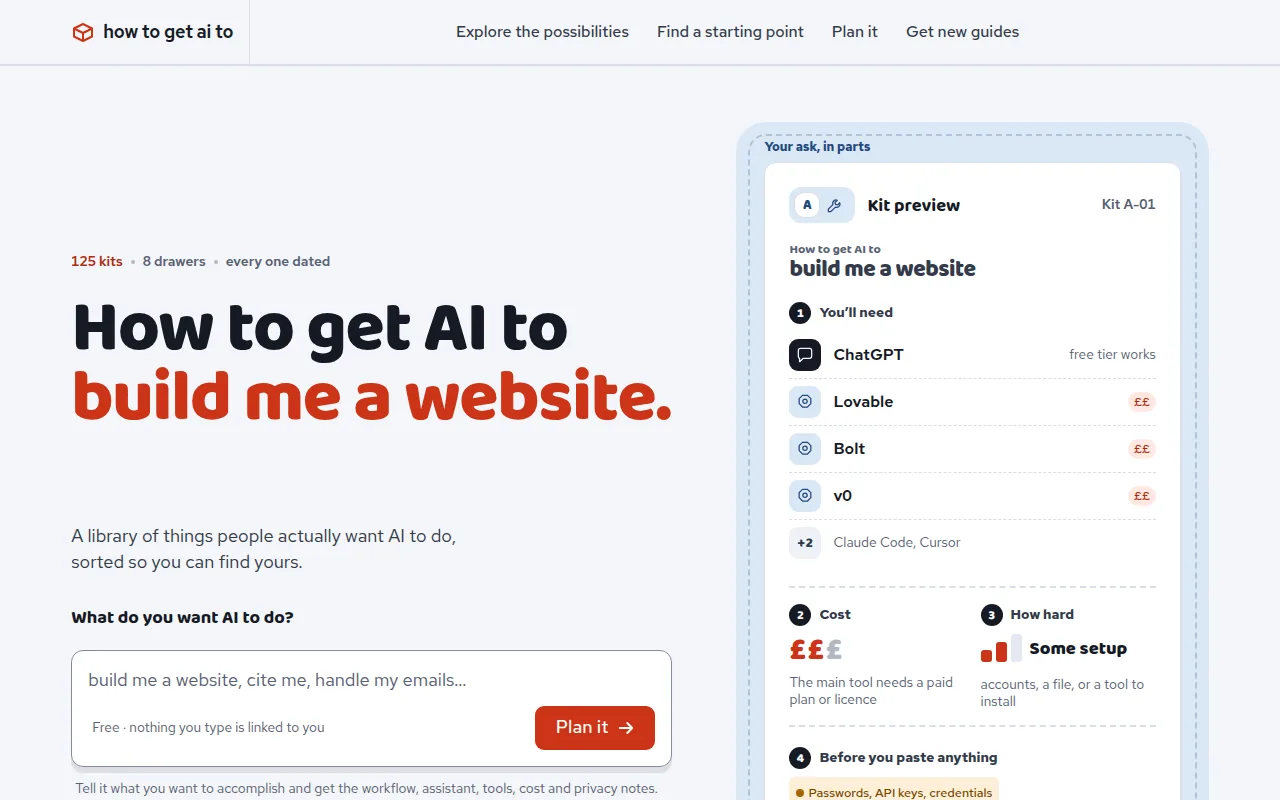
A library of 120 practical guides, each answering one question: how to get AI to build you a website, cite you, sound like you. 86 of them work on free tiers.
Its reel, from the Picture House
This reel for How to get AI to is Launch Video Maker's work too. Every guide's address reads like the end of its question, so a real one to borrow is howtogetaito.com/sound-like/me.
How to get AI to sound like me
How to get AI to: Typographic kinetic poem. Lo-fi hip-hop, 30 seconds.
Made by Launch Video Maker for How to get AI to. Vertical, 9:16, shown as it appears in LVM's public gallery.
The story
Every guide on How to get AI to answers one question, and the URL reads like the end of it: howtogetaito.com/sound-like/me, howtogetaito.com/build-me/a-website. Simple.
There are 120 guides across 8 categories: build something, write and communicate, grow my business, research and discover, create something, teach me, get work done, and everyday life. 86 of them can be followed start to finish on free tiers. Each one carries a cost band, a difficulty level, privacy notes, its sources, published and last-updated dates, and a Markdown copy you can keep.
The homepage is one big prompt. Type what you want, hit "Plan it", and in about ten seconds you get a plan built from a fixed catalogue of workflows and tools, never invented ones. Those plans are marked unreviewed. The guides are reviewed: we draft them in our own voice with ScriptGrain from a fact sheet per topic, then read every one in full and check it against its sources before it goes live. No cookies unless you sign in, no third-party trackers.
Who it is for. Anyone who has typed a half-formed request into an AI assistant, got something mediocre back, and wondered whether the problem was them. It usually wasn't. The library is written for people who want a thing done, a website built or a voice matched, and who don't much care how the machinery works. No jargon required. If a term does turn up, the first mention links to a plain-English glossary, so you're never left guessing what a token is.
How it works in practice. You start in one of two places. Browse the eight categories by the outcome you want, or type your ask into the homepage box and hit "Plan it". Either way you land on something concrete: what you'll be able to do, what you need, the steps, copy-and-paste prompts, how to check the result, and what not to hand to an AI. Each guide names the assistant and tools, states a cost band from free to £££, and gives a difficulty from one to three. You follow it in order. Then you check the output against the guide's own advice, which matters more than it sounds.
What makes it different. Most AI advice is either a vague listicle or a product pitch. This is neither, and it isn't neutral either. The tools recommended are the ones the author uses to run a software studio, and a few are the publisher's own. Those are always disclosed, and you can exclude them entirely. Every recommendation also comes from one catalogue, so guides and plans draw on the same named assistants and tools rather than whatever sounded plausible that day. Boring? Slightly. Trustworthy? That's the idea.
Where it stands now. For agents, the same catalogue is available through a recommendation API and an MCP server. It's a working thing, not a promise.
What it deliberately doesn't do. It doesn't send you away empty-handed when your ask isn't in the library; it writes you a plan instead. It also doesn't pretend a plan is a reviewed guide, invent tools that don't exist, or claim an AI should do everything. Each guide says what not to hand over, which is a rare courtesy in this corner of the internet. So, no magic. Just a tidy shelf of answers, each one stopping where the honest advice stops, which is how a reference ought to behave.
What it does
- 120 guides, each answering exactly one practical question
- 8 categories, from building things to everyday life
- 86 guides work start to finish on free tiers
- Every guide shows cost, difficulty, privacy notes, sources and dates
- "Plan it" composes a plan in about ten seconds
- Plain-English glossary: agent, MCP, token, hallucination and more
More ventures
Hilyt.it
Live
Open, AI-readable profiles for people and businesses: a crawlable page, schema.org identity markup and a plain-text card for the models, with no login wall. Free.
Assets for three.js
Live
Original GLB model packs for three.js and WebGL: London housing, high streets, architecture, building sites, and parks, play and sport. 1,095 component models and 135 assemblies, three levels of detail on every model, and the triangle count printed up front.
What is GEO
Live
A free, single-page, source-linked field guide to Generative Engine Optimisation for business owners and marketers. No product, no pitch: what GEO is, how AI answers pick sources, and what's worth doing.