Adapt Progress Evolve · All work
Live · The Information Kiosk
What is GEO
One free page about GEO, every claim linked to its source, and nothing for sale at the counter.
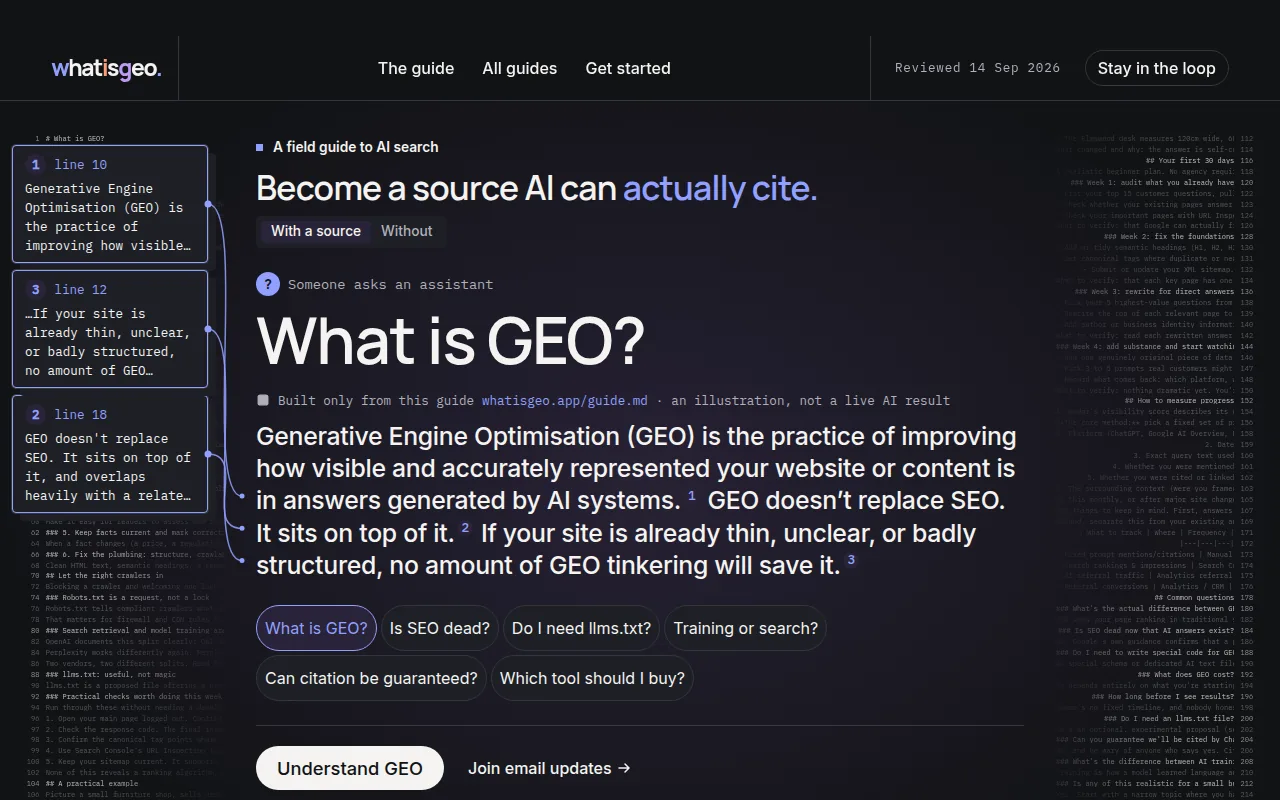
A free, single-page, source-linked field guide to Generative Engine Optimisation for business owners and marketers. No product, no pitch: what GEO is, how AI answers pick sources, and what's worth doing.
Its reel, from the Picture House
Launch Video Maker's reel for What is GEO. The site's code is public on GitHub under the MIT licence.
What is GEO: Handwritten notebook. Neo-soul, 30 seconds.
Made by Launch Video Maker for What is GEO. Vertical, 9:16, shown as it appears in LVM's public gallery.
The story
We built What is GEO because the topic kept getting buried under hype. So it's one page, it's free, and there's nothing to buy. That's the whole deal.
It covers what GEO is, how it differs from SEO, and how a search-backed AI answer actually happens: query, discover, select, answer. Then come six principles, and each one is labelled as a platform requirement, a research finding or plain advice. Never blurred together, because they're not the same thing. There's a section on letting the right crawlers in (search retrieval and model training are different permissions), a worked rewrite of a product page, a 30-day starter plan that assumes no budget, and a repeatable way to measure progress with a fixed prompt set. Ten FAQs too.
Every claim links to its source, from Google Search Central to the GEO research paper from KDD 2024 and the OpenAI and Perplexity crawler docs. The guide practises what it preaches: it's served as Markdown and plain text alongside an llms.txt, and the code is public on GitHub under MIT. We can't promise you a placement in AI answers, and neither can anyone else. Read it, check the sources, judge for yourself.
Who it is for. Business owners and marketers who keep hearing that AI is about to rewrite search, and can't tell what's true. Maybe you run a small shop with a website and two people behind it. Maybe you handle marketing for a bigger outfit. Either way, the problem is the same: the advice comes loud, confident and unsourced. So you can't tell a platform requirement from a hopeful guess. This page exists to sort that out.
How it works in practice. You start with the basics: what GEO is, and how it sits on top of SEO rather than replacing it. Then you follow one AI answer through its stages (query, discover, select, answer), so you see where your content could actually enter. Next come the six principles, each labelled. After that, you check crawler access, read the worked rewrite of a product page, and follow the 30-day plan. Finally, you run the same fixed prompt set each time and compare.
What makes it different. Most GEO material blends three different kinds of claim into one confident voice. A rule from a platform, a result from a research paper and someone's good advice all get the same tone. This guide keeps them apart, and labels every one. That makes it a little less exciting to read. It's also more honest. Every claim links to its source, so you can check us rather than trust us.
It draws a second line too, on crawlers. Letting a search retrieval crawler in and letting a model training crawler in are separate permissions, and it is easy to set one while meaning the other. The guide explains the split plainly, using the OpenAI and Perplexity crawler docs, so you can decide each one on purpose. Measurement gets the same treatment. A vendor's visibility score describes its own sample of prompts and platforms, which tells you little about yours. A fixed prompt set you control does.
Where it stands now. It's live and free, last reviewed in September 2026, and the ten FAQs at the end cover the questions people ask most, from cost and timelines to whether you need an llms.txt at all.
What it deliberately does not do. It doesn't sell you anything, because there's nothing to sell. It doesn't promise citations, and neither does anyone honest, since GEO shifts the odds and guarantees nothing. It won't hand you a fixed timeline for results. It doesn't ask you to write special code, because no special schema or dedicated AI text file is required. The llms.txt is an optional, experimental proposal, and the guide treats it that way. You get a clear map and a way to measure. What you do with it is up to you.
What it does
- Plain-English GEO basics, including GEO vs SEO
- Query, discover, select, answer: how AI answers happen
- Six principles, each labelled requirement, finding or advice
- Worked product page rewrite and a no-budget 30-day plan
- Fixed prompt set for measuring progress, plus ten FAQs
- Every claim linked to its source; code public under MIT
More ventures
Can You Use AI
Live
Straight UK answers to "Can you use AI to…?" questions: 42 of them, each opening with a clear verdict, then how to do it well, the rules and risks, and the sources. Free, no sign-up.
Is There a Thing
Live
A directory that answers "is there an app, tool or AI for that?" one question per page: an honest yes, partly or not really, plus the real tools that do it, their prices and the catch.
reviewsnot
Live
A free troubleshooting library for when reviews are not showing, not working, not real or on the wrong listing. 13 problem pages (12 on Google, 1 on Amazon), each with the likely cause first and the fix in steps.