Adapt Progress Evolve · Live
Using AI As
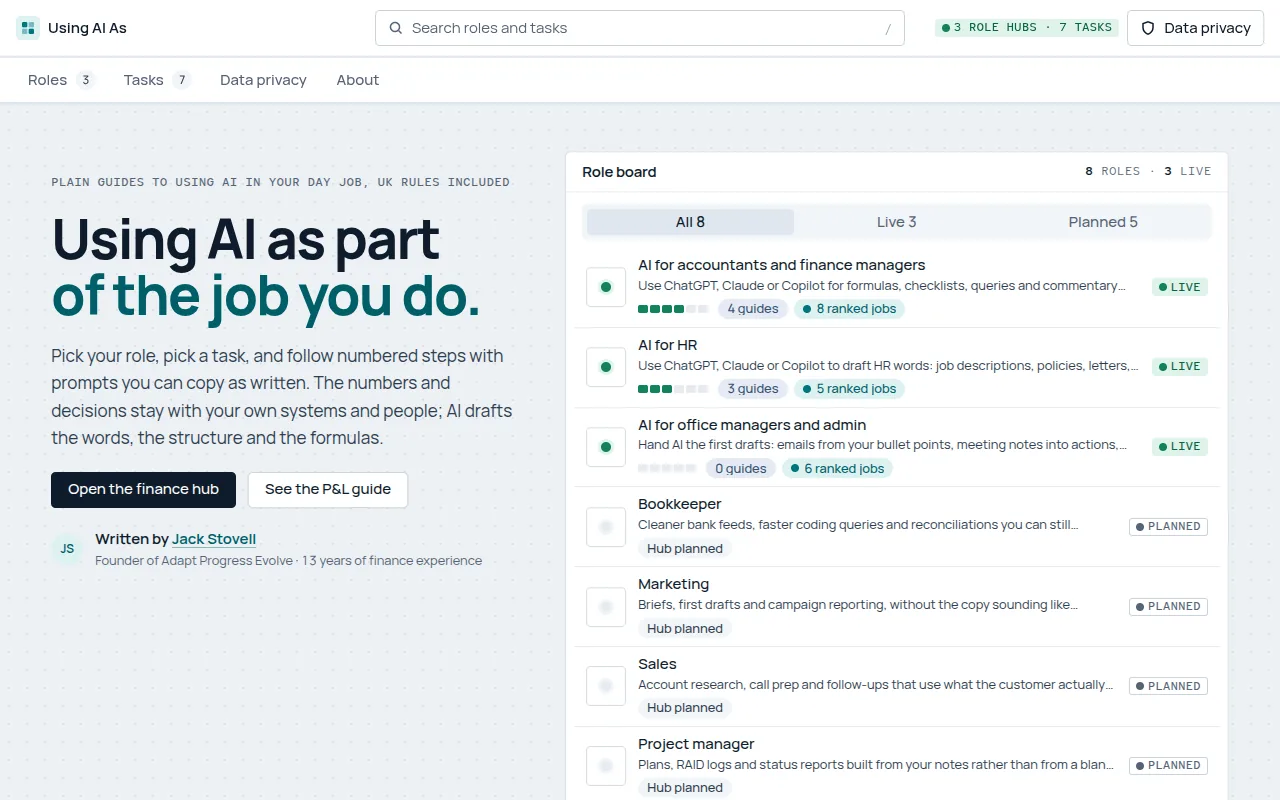
Plain guides to using AI in your day job, for people in UK finance, HR and office admin. Numbered steps, copyable prompts and the UK rules, with the numbers and decisions kept with people.
About
Using AI As answers a question a lot of office workers are quietly asking: can I use ChatGPT for this part of my job without getting into trouble? The answer is usually yes, for the drafting, and no, for the numbers and the decisions.
That rule runs through every page. The ledger, the HR system and the bank hold the figures. AI drafts words, structure and formulas, and a person checks and approves. The site launched on 1 October 2026 with three role hubs, for accountants and finance managers, HR, and office managers, and seven task guides: bank reconciliation, cash-flow forecasting, ChatGPT and Xero, building a P&L from a trial balance, job descriptions, HR policies and performance reviews.
Who it is for. People in UK finance teams, HR and office admin who want to use ChatGPT, Claude or Microsoft Copilot at work without pasting in confidential or personal data. You don't need to know how the models work. You need to know what to hand over, what to keep, and which rules apply.
How it works in practice. Pick your role, then pick a task. Each role hub ranks what to hand to AI first, lowest risk first, says what to keep human and lists what should never go into a consumer AI tool. Each task guide gives numbered steps, prompts you can copy as written and a checkpoint after every step telling you what you should now see, followed by the common mistakes and a sign-off checklist. The P&L guide comes with a downloadable Excel workbook built on a made-up company's trial balance.
What makes it different. The UK rules are on the page, not left as an exercise. Pages cite primary sources, including the ICO, GOV.UK, Acas, Xero Central, Microsoft, OpenAI and Anthropic, so you can read the original. If a detail isn't in a source, it stays out. Dates are honest: the updated date changes only when the content does. Examples use fictional companies. Where a page mentions one of our own products, it is labelled as ours, never changes the advice, and there are never more than three on a page.
Where it stands now. Ten pages are live, and the site lists what is planned next in the open: month-end close, management accounts and budget commentary for finance, recruitment screening, interview questions, onboarding and HR letters, and a run of office tasks such as meeting notes and supplier chasers. Every page also has a markdown mirror, and there is an llms.txt for AI assistants.
What it deliberately does not do. It is not financial, legal, tax or HR advice, and it says so. It doesn't let AI decide a performance rating, set pay or tell you what the law says. It doesn't use cookies or accounts. And it doesn't pretend AI should touch everything: some jobs stay with the person who signs them off.
Key features
- 3 role hubs: finance, HR and office managers
- 7 task guides, from bank reconciliation to HR policies
- Numbered steps with a checkpoint after every one
- Prompts you can copy as written
- Primary sources: ICO, GOV.UK, Acas, Xero, Microsoft
- No cookies, no accounts, a markdown copy of every page
Other Ventures
-
ScriptGrain — Live
AI content that sounds like you, not a chatbot. ScriptGrain measures how you write across 45 reference points, builds a voice profile, and scores every draft against it.
-
Launch Video Maker — Live
Give it your web address and it turns your site into a short motion reel with music and sound effects, for YouTube, Shorts, Reels and TikTok. You approve every fact. Pay once from £9.
-
visibility to ai — Live
Checks whether ChatGPT, Claude, Gemini and Perplexity name and cite your company when your buyers ask. It reads every answer, quotes every mention, and gives a plain verdict per question.